A Rare Congenital Anomaly of Meckel’s Cave Presenting as Trigeminal Neuralgia
BT27 4BS
Abeer Elamin
Abeer Elamin, Ana Poveda, Andrea Richards, Alexandra Perks, Jon Higham
Trigeminal neuralgia (TN) is characterised by severe, sudden, electric shock-like facial pain. Common causes for TN include vascular compressions or space occupying lesions. Congenital anomalies such as absence of Meckel’s cave are rare alternative causes. Meckel’s cave is a cerebrospinal fluid–filled pouch in the middle cranial fossa that houses the trigeminal (Gasserian) ganglion and proximal branches of the trigeminal nerve. Its absence may lead to trigeminal nerve dysfunction due to loss of structural protection and increased mechanical vulnerability.
A 36-year-old female, with anxiety and reflux but otherwise well, was referred for dental extractions and reported a three-week history of right-sided chin and lip numbness. This progressed to episodes of severe, electric shock-like pain affecting the entire right face, lasting a few seconds, paroxysmal in nature, and rated 10/10 on the visual analogue scale.
Clinical examination revealed mild right-sided hypoesthesia, with no intraoral abnormalities or other cranial nerve deficits.
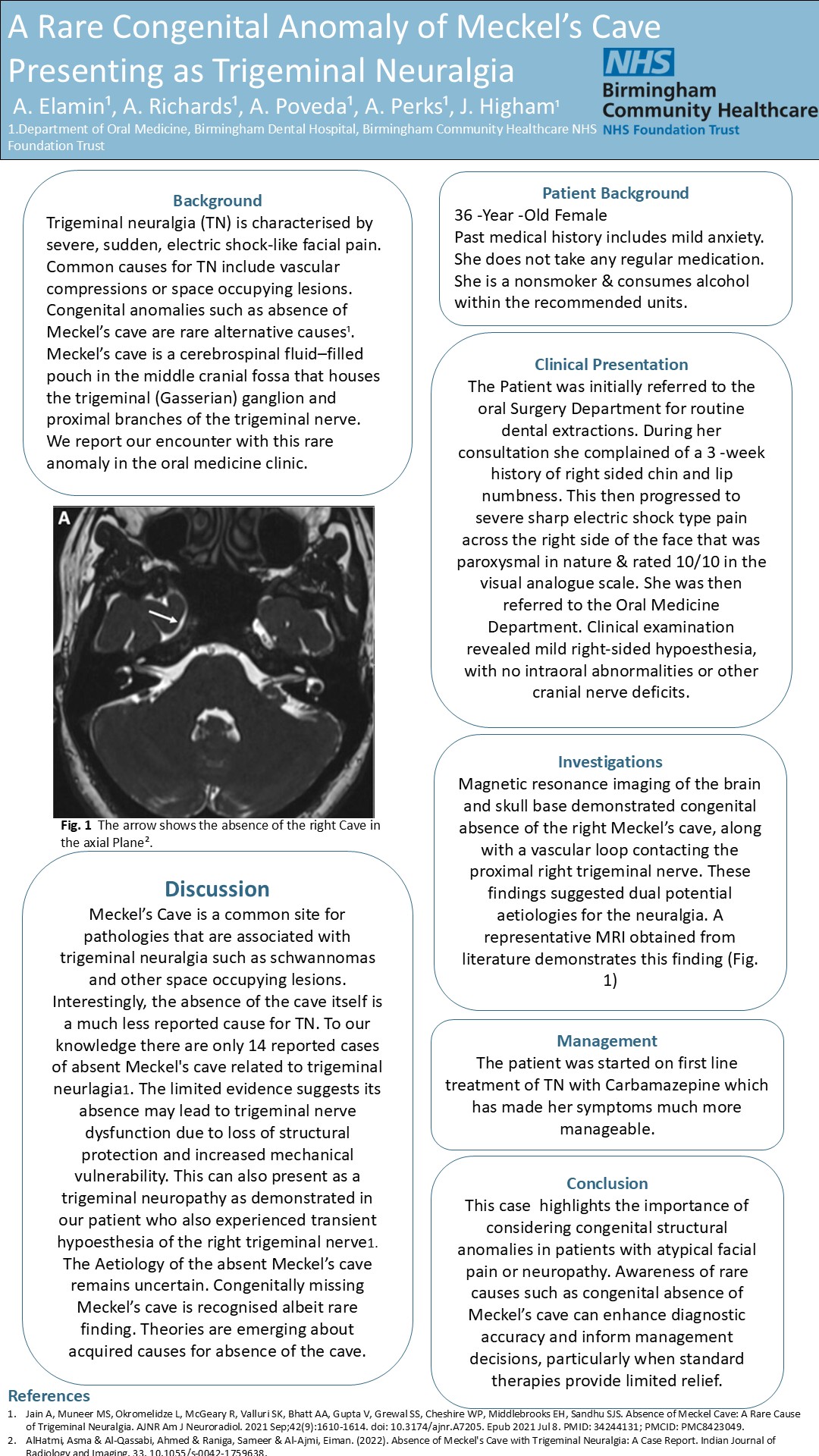
Magnetic resonance imaging of the brain and skull base demonstrated congenital absence of the right Meckel’s cave, along with a vascular loop contacting the proximal right trigeminal nerve. These findings suggested dual potential aetiologies for the neuralgia.
A diagnosis of trigeminal neuralgia secondary to congenital absence of Meckel’s cave, with possible contribution of vascular compression, was made. Treatment with carbamazepine 100 QDS was initiated however the patient was reluctant to take it QDS. She is taking Carbamazepine 100mg BD, which reduced the frequency and intensity of painful paroxysms though mild persistent discomfort persisted.
This case highlights the importance of considering congenital structural anomalies in patients with presenting with facial pain or neuropathy. Awareness of rare causes such as congenital absence of Meckel’s cave can enhance diagnostic accuracy and inform management decisions, particularly