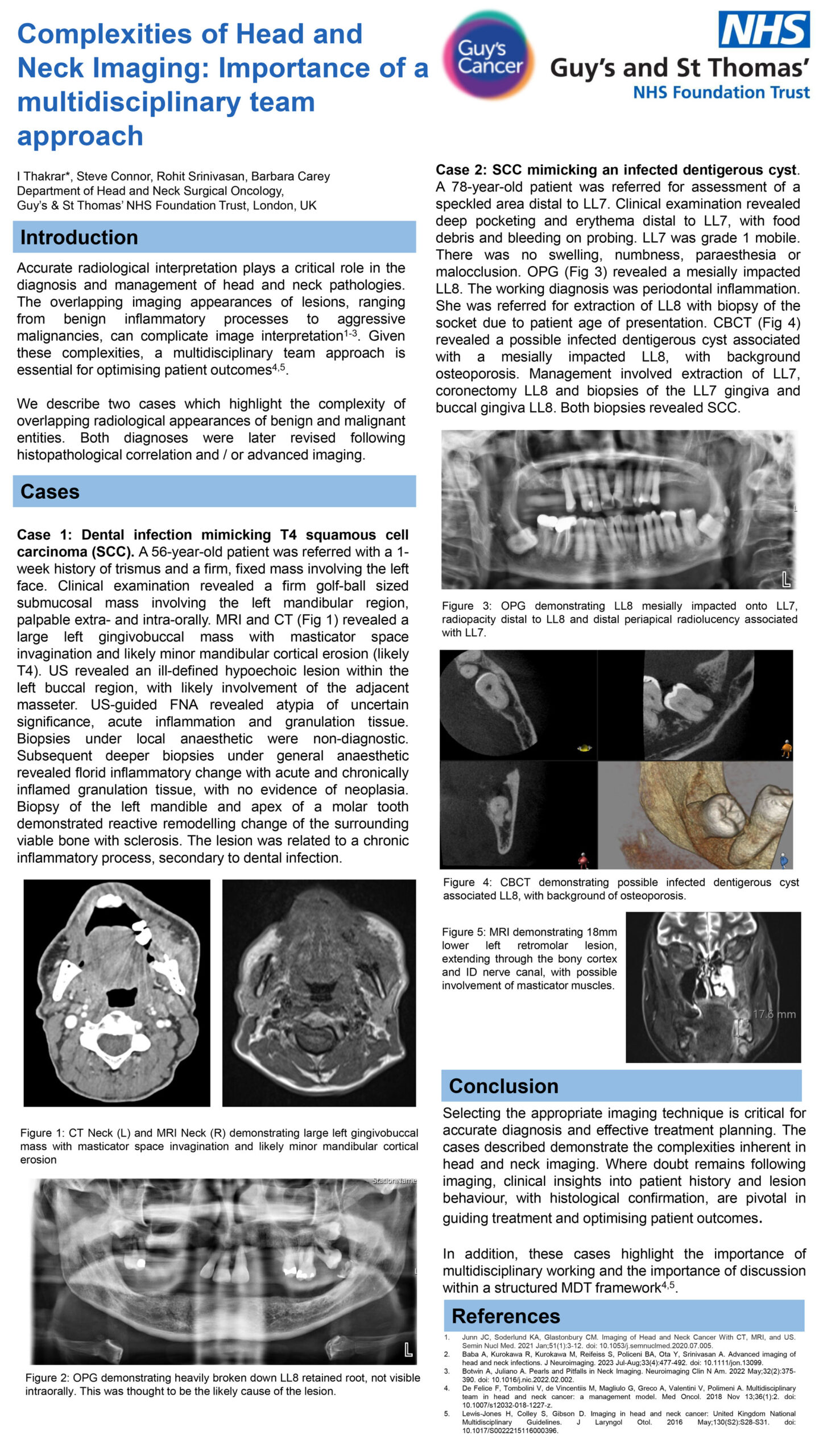
Complexities of Head and Neck Imaging: Importance of a multidisciplinary team approach
CR10
Ishita Thakrar
I Thakrar*, Steve Connor, Rohit Srinivasan, Barbara Carey
Background:
Accurate radiological interpretation plays a critical role in the diagnosis and management of head and neck pathologies. The overlapping imaging appearances of lesions—ranging from benign inflammatory processes to aggressive malignancies—can complicate image interpretation. Given these complexities, a multidisciplinary team approach is essential for optimising patient outcomes.
Method:
Case 1: Dental infection mimicking T4 squamous cell carcinoma (SCC). A 56-year-old patient was referred for assessment with a 1-week history of trismus and firm, fixed swelling involving the left face. Clinical examination revealed a firm golf-ball sized submucosal mass involving the left mandibular region, palpable extra- and intra-orally. MRI and CT revealed a large left gingivobuccal mass with masticator space invagination and likely mandibular cortical erosion. Biopsies under local anaesthetic were non-diagnostic. Subsequent deep biopsies under general anaesthetic revealed florid inflammatory change with acute and chronically inflamed granulation tissue formation.
Case 2: SCC mimicking an infected dentigerous cyst. A 78-year-old patient was referred for assessment of a speckled area distal to LL7. Clinical examination revealed erythema distal to LL7. The working diagnosis was periodontal inflammation. CBCT revealed a possible infected dentigerous cyst associated with a mesially impacted LL8. The case was referred urgently to oral surgery where biopsy of the gingiva of LL78 revealed SCC.
Both cases highlight the complexity of overlapping radiological appearances of benign and malignant entities. Both diagnoses were later revised following histopathological correlation and / or advanced imaging.
Conclusion:
Selecting the appropriate imaging technique is critical for accurate diagnosis and effective treatment planning. The cases described demonstrate the complexities inherent in head and neck imaging. Where doubt remains following imaging, clinical insights into patient history and lesion behaviour, with histological confirmation, are pivotal in guiding treatment and optimising patient outcomes.