Non-odontogenic Radiopaque Findings in Panoramic Radiographs.
CR7
Isabel Dias
Isabel Dias; Mr Shankar Narayan.
Non-odontogenic Radiopaque Findings in Panoramic Radiographs: A Case Series
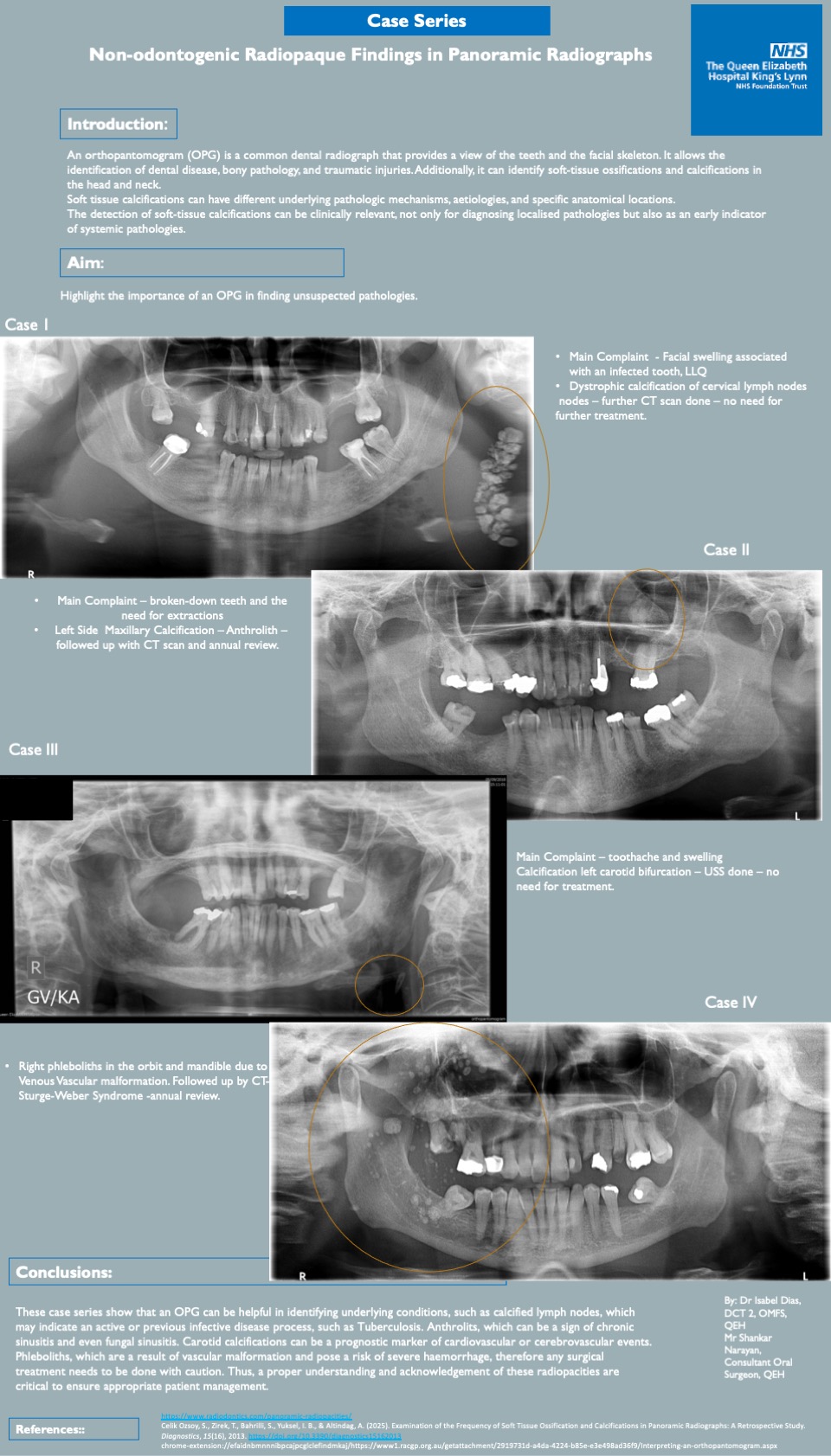
An orthopantomogram (OPG) is a common radiograph used in dentistry that provides a view of teeth and the facial skeleton. It allows the identification of dental, bony disease, and traumatic injuries. Additionally, it can identify soft-tissue calcifications in the head and neck.
Soft tissue calcifications and ossifications can have different underlying pathologic mechanisms, aetiologies, and specific anatomical locations.
The detection of soft-tissue calcifications can be clinically relevant, not only for diagnosing localised pathologies but also as an early indicator of systemic pathologies.
Lesions such as carotid calcifications, lymph node calcifications, and metastases are examples of radiopacities that a simple OPG can allow to detect and prompt further investigation.
In our Oral Surgery Department at the Queen Elizabeth Hospital, King’s Lynn, we’ve come across some of these incidental findings, which could signify underlying conditions.
With these case series, we aim to demonstrate that panoramic imaging can be diagnostically essential but also challenging to understand and identify radiopacities due to its 2-dimensional nature. However, a proper understanding and acknowledgement of these radiopacities is critical to ensure appropriate patient management.
References:
https://www.radiodontics.com/panoramic-radiopacities/
Celik Ozsoy, S., Zirek, T., Bahrilli, S., Yuksel, I. B., & Altindag, A. (2025). Examination of the Frequency of Soft Tissue Ossification and Calcifications in Panoramic Radiographs: A Retrospective Study. Diagnostics, 15(16), 2013. https://doi.org/10.3390/diagnostics15162013
chrome-extension://efaidnbmnnnibpcajpcglclefindmkaj/https://www1.racgp.org.au/getattachment/2919731d-a4da-4224-b85e-e3e498ad36f9/Interpreting-an-orthopantomogram.aspx