Pleomorphic adenoma of hard palate: Review of updated literature and “case report”
CR21
Roba AlSahman
Lujain AlSahman 1, Roba AlSahman 2
Rational: Pleomorphic adenoma (PA) is a rare benign tumor mainly affecting the major salivary glands,
known for its diverse histological appearances that can mimic malignancies. When it occurs in the hard
palate it present diagnostic and management challenges compared to other sites due to the anatomical
location and potential proximity to critical structures. This case reports a rare presentation PA starting as
an ulcer, alongside a review of rare cases of PA reported in last 5 years. We aim to highlight clinical
challenges and emphasize the need for awareness in diagnosis of this diverse entity amongst the
clinicians before reaching a definitive conclusion.
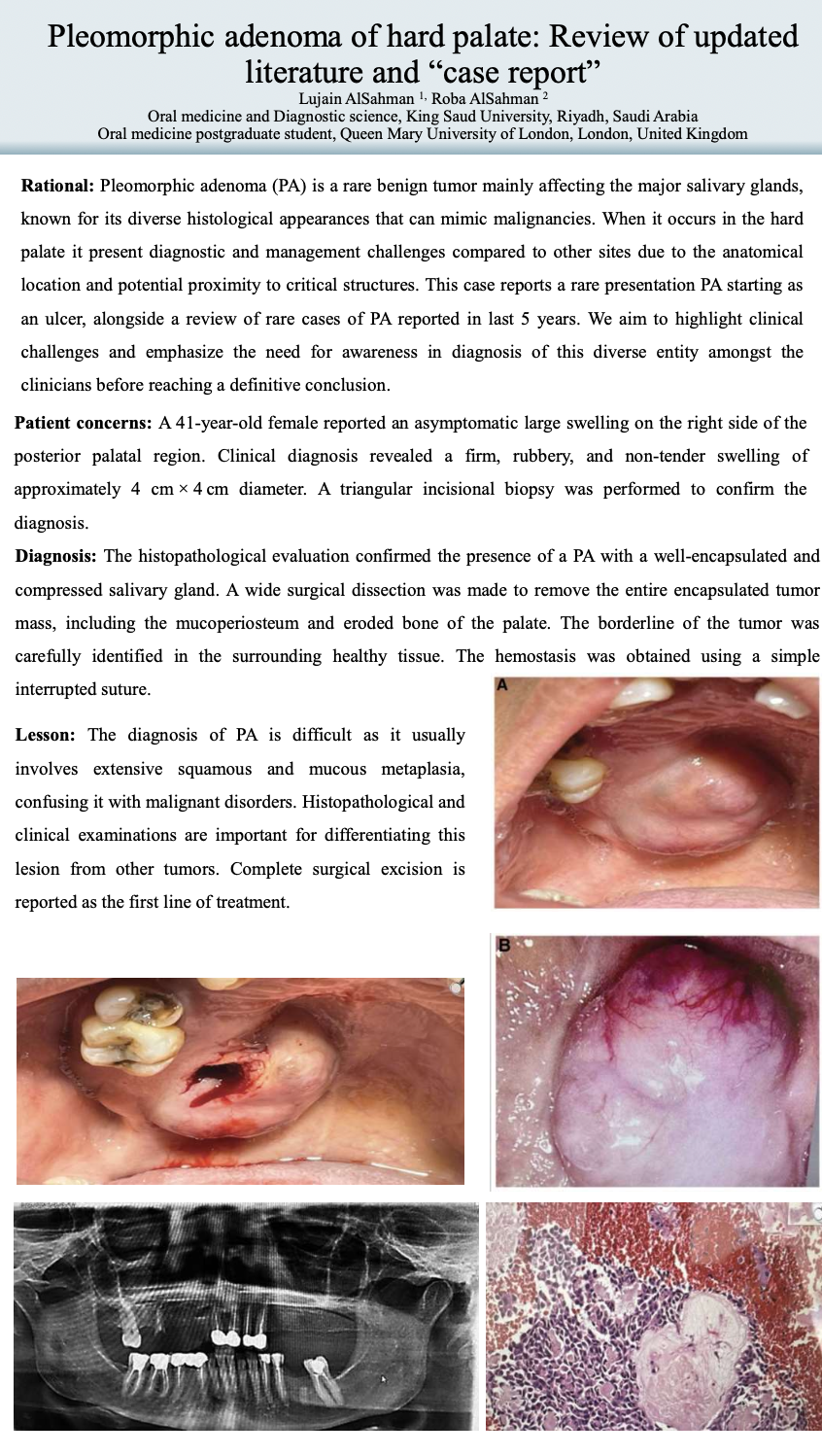
Patient concerns: A 41-year-old female reported an asymptomatic large swelling on the right side of the
posterior palatal region. Clinical diagnosis revealed a firm, rubbery, and non-tender swelling of
approximately 4 cm × 4 cm diameter. A triangular incisional biopsy was performed to confirm the
diagnosis.
Diagnosis: The histopathological evaluation confirmed the presence of a PA with a well-encapsulated and
compressed salivary gland. A wide surgical dissection was made to remove the entire encapsulated tumor
mass, including the mucoperiosteum and eroded bone of the palate. The borderline of the tumor was
carefully identified in the surrounding healthy tissue. The hemostasis was obtained using a simple
interrupted suture.
Lesson: The diagnosis of PA is difficult as it usually
involves extensive squamous and mucous metaplasia,
confusing it with malignant disorders. Histopathological and
clinical examinations are important for differentiating this
lesion from other tumors. Complete surgical excision is
reported as the first line of treatment.